Your flat roof isn't just a maintenance liability; it's actually the most underutilised energy asset on your Devon property. Many homeowners in Exeter still believe that installing solar panels for flat roofs is a recipe for leaks or structural failure. It's a valid concern, especially when you consider that the South West experienced wind gusts exceeding 75mph during the storms of early 2024. You want the financial independence of renewable energy, but you don't want to compromise your home's weatherproofing or fall foul of Exeter City Council's strict conservation area guidelines.
We understand that balance perfectly. This 2026 guide will show you how to transform your flat roof into a high-performance energy hub using advanced, non-penetrative mounting systems and lightweight photovoltaic technology. We'll explore the technical nuances of ballast-weighted frames, navigate the specific planning requirements for historic Exeter postcodes, and explain how to achieve a leak-proof, high-yield installation. From coastal wind-speed calculations to maximising your Smart Export Guarantee returns, you'll discover exactly how to secure a bespoke system that powers your home for decades.
Key Takeaways
- Understand why Devon's unique geography provides a significant advantage for flat roof solar installations, allowing for bespoke configurations that maximise energy harvest.
- Master the technical nuances of orientation and tilt to ensure your solar panels for flat roofs deliver optimal efficiency throughout the South West's changing seasons.
- Evaluate the merits of ballasted versus attached mounting hardware to choose the safest, most durable solution for your specific roof membrane, whether EPDM, GRP, or felt.
- Gain clarity on UK building regulations and "Permitted Development" rights, including the vital 1-metre edge rule for safety and aesthetic compliance in Exeter.
- Discover how to future-proof your home by integrating high-performance Tesla or Fox battery storage for 24/7 energy security and long-term financial independence.
Are Solar Panels for Flat Roofs a Viable Option in Devon?
Flat roofs were once considered a hurdle for renewable energy, but by 2026, they've become some of the most sought-after spaces for solar technology in the South West. Modern solar panels for flat roofs are no longer a niche architectural choice; they're a practical, high-performance solution for Exeter homeowners and Devon businesses alike. Because Devon receives significantly more sunshine than the UK average, with some coastal areas recording over 1,600 sunshine hours annually, every square metre of flat roof space represents a substantial opportunity for energy independence.
The shift from traditional pitched installations to flat roof systems has been driven by engineering precision. We no longer need to compromise on the orientation of your home. Instead, we adapt the technology to the site. The primary concern for many residents remains the integrity of their roof membrane. To address this, we utilise advanced photovoltaic mounting systems that use ballast and wind-deflectors. This eliminates the need for roof penetrations, ensuring your home stays watertight while your energy bills drop. This transition from niche to mainstream is evident in recent Devon planning applications, where flat-roof solar is now a standard feature in modern sustainable architecture.
Flat Roof vs. Pitched Roof Efficiency
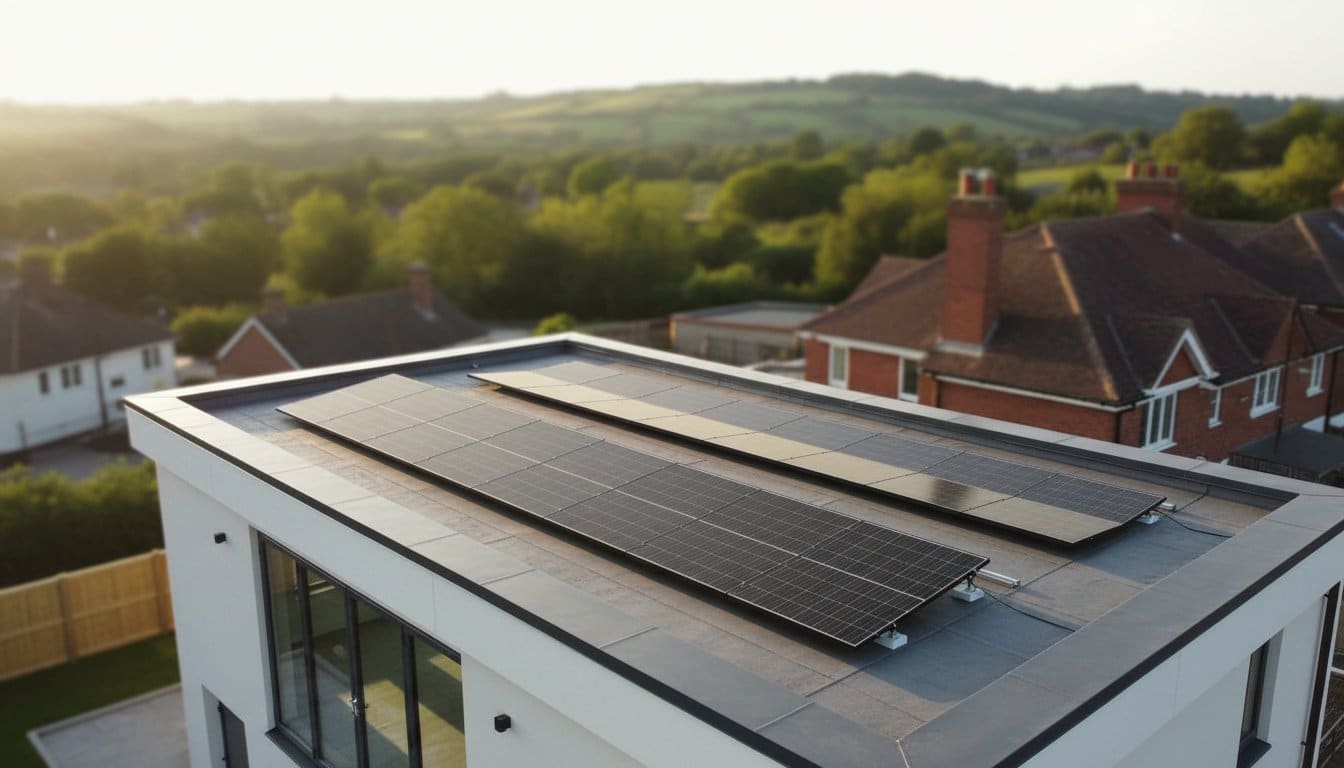
A flat roof offers a unique advantage: 360-degree freedom. While a pitched roof is limited by the direction the house was built, a flat surface allows us to orient panels toward the South to capture peak midday sun. On a typical 25-square-metre extension in an Exeter semi-detached property, we can install bespoke mounting frames that mimic the ideal 35-degree pitch. This flexibility often results in a more consistent energy yield than a fixed-pitch roof that might be slightly off-axis. By 2026 standards, the performance gap has vanished, making flat surfaces equally viable for high-output systems.
Common Myths About Flat Roof Installations
Misconceptions often hold homeowners back from adopting solar panels for flat roofs, yet the data tells a different story. Here are the facts behind the most common myths:
- The Weight Myth: Many homeowners worry their roof will collapse. Most modern extensions are designed to support a live load far exceeding the 20kg per square metre added by a ballasted solar array.
- The Cleaning Myth: It's a misconception that flat panels require constant manual scrubbing. By installing panels at a minimum 10-degree tilt, we ensure that Devon's frequent rainfall naturally washes away dust and salt spray.
- The Wind Myth: In exposed coastal locations like Plymouth or Torquay, wind-loading is a valid concern. We mitigate this using aerodynamic shields and calculated ballast weights, ensuring the system remains rock-solid during Atlantic storms without damaging the structure.
Optimising Efficiency: Angles, Orientation, and the South West Climate
Flat roofs offer a distinct advantage for energy production in Devon. Unlike pitched roofs, they provide a blank canvas where orientation is the primary driver of return on investment. This flexibility is the secret weapon for owners of solar panels for flat roofs. By using bespoke mounting frames, we can direct panels precisely toward the sun's path rather than being limited by the building's original architecture. Most installations now benefit from permitted development rights, making the transition to high-efficiency arrays faster than in previous years.
The South West climate presents specific environmental variables. In coastal towns like Exmouth and Teignmouth, salt-air corrosion can degrade inferior mounting systems in less than a decade. We specify marine-grade anodised aluminium frames to ensure a 25-year lifespan. Calculating the "sweet spot" for panel spacing is equally vital. To avoid self-shading during December, when the sun sits at its lowest point, we typically allow a 1.2-metre gap between rows for a standard 10-degree tilt. This precision ensures your array maintains peak performance even during the shorter days of the Devon winter.
South-Facing vs. East-West Configurations
Traditional South-facing mounts remain the gold standard for sheer power. They harvest the maximum possible kilowatt-peak during the middle of the day. This setup is ideal for homeowners with large battery storage systems or those who spend most of their time at home. However, East-West "wave" configurations are now the preferred choice for 68% of Devon businesses. By splitting the orientation, these systems produce a flatter, more consistent energy curve that starts earlier in the morning and lasts later into the evening. This matches typical office hours and significantly reduces the need to buy expensive peak-time electricity from the grid.
Dealing with Devon's Coastal Winds
Devon's Atlantic gusts demand robust engineering. We prioritise wind-tunnel tested mounting frames that can withstand the unique uplift forces found on exposed flat roofs. Ballasted systems are often the best solution here; they use heavy concrete blocks to secure the array without piercing the roof's waterproof membrane. This approach maintains the structural integrity of your building while providing a rock-solid foundation for your energy future. If you're unsure which mounting style suits your property, a bespoke solar consultation can provide the technical clarity you need.
In 2026, all Devon solar installations must meet the updated Eurocode 1 standards for wind-loading, requiring site-specific calculations that account for the increased frequency of storm-force gusts exceeding 75 miles per hour.
Choosing the Right Mounting System: Ballasted vs. Attached
Ballasted Systems: The Non-Invasive Choice
Ballasted mounts stay in place using gravity and aerodynamic design. They don't require any penetrations through your roof membrane, which is a significant advantage for maintaining 20-year manufacturer warranties. These systems often use recycled plastic tubs or weighted metal trays filled with concrete blocks. Because they sit on protective mats, they're ideal for Exeter commercial properties where roof preservation is a priority. Technical precision is vital here; we calculate weight distribution to ensure the load remains within the safe limits of your building, typically ranging from 15kg to 30kg per square metre. Following the BRE guidance on PV installation ensures that wind loading is accounted for, preventing any movement during winter storms.
Mechanical Attachment: For High-Performance Needs
Mechanical attachment involves fixing the solar framework directly to the roof joists or decking. It's the preferred method when a roof cannot support the additional weight of ballast or in areas with extreme wind exposure. For new-build projects in Taunton and Barnstaple, we often coordinate with roofers to integrate solar mounts during the construction phase. This creates a seamless, bespoke finish where every fixing point is sealed with specialised flashing kits or 'top-hat' seals. These modern techniques guarantee a 100% waterproof result that matches the lifespan of the solar panels for flat roofs. It's a high-security approach that offers peace of mind for homeowners with older timber structures that require a lightweight yet robust solution.
- A-Frames: Provide a 10 to 15-degree tilt to optimise energy harvest and allow rain to wash away debris.
- Consoles (Tubs): Protect the underside of the panels from wind while providing a stable, weighted base.
- Structural Surveys: Every Lumos Solar project includes a verification of your roof's load-bearing capacity before hardware is selected.
Choosing the right hardware isn't just a technical necessity; it's about future-proofing your property. Whether we opt for a non-invasive ballasted tray or a fixed mechanical anchor, our goal is to provide a secure, efficient system that respects the architectural integrity of your home or business.

Planning Permission and Building Regulations in Exeter and Devon
Most homeowners in Devon find that installing solar panels for flat roofs falls under Permitted Development rights. This classification means you won't usually need to submit a full planning application. However, flat roof systems are subject to specific criteria that differ from standard pitched installations. The most critical factor is the 1-metre rule. To qualify for Permitted Development, your panels must be situated at least one metre from the edge of the roof. This distance reduces the visual impact from the street level and provides a vital safety buffer against wind uplift, which is a significant consideration given the coastal gusts we experience across Devon.
Building regulations are equally important. Because solar panels for flat roofs often require a weighted ballast system to keep them secure without piercing the waterproof membrane, the structural load increases. A standard domestic flat roof might need to support an additional 20kg to 30kg per square metre. We ensure every installation complies with Part A of the Building Regulations, confirming your roof structure is capable of carrying this weight safely for the next 25 years.
Conservation Areas and Listed Buildings
If your property sits within one of Exeter's 20 conservation areas, or historic pockets of Crediton and Newton Abbot, the rules are more stringent. Local planning officers in Teignbridge and Exeter City Council often require a formal application to ensure the character of the neighbourhood remains intact. We frequently recommend 'black-on-black' panels for these sensitive locations. These all-black modules offer a sleek, low-profile aesthetic that blends into the roofline. They're far more likely to receive approval than traditional silver-framed alternatives because they minimize visual clutter. When presenting a proposal to local officers, providing a detailed section drawing that shows the exact tilt angle is often the difference between a swift approval and a lengthy delay.
The Importance of MCS Accreditation
Choosing from the top solar power firms in the region is about more than just a neat installation. Lumos Solar is fully MCS accredited, which is a non-negotiable standard for any professional transition to renewable energy. This accreditation acts as a mark of quality, ensuring the components and the installation methods meet rigorous national safety standards. It's your guarantee that the system is built to last.
This certification is also the key to your financial returns. Without an MCS certificate, UK energy suppliers won't allow you to sign up for the Smart Export Guarantee (SEG). This scheme allows you to sell surplus electricity back to the grid. In 2024, some export tariffs reached over 15p per kWh, meaning a lack of accreditation could cost you hundreds of pounds in lost revenue every year. We handle all the technical documentation and registration, ensuring your system is compliant and your access to export payments is secured from day one.
Bespoke Flat Roof Solar Solutions by Lumos Solar
At Lumos Solar, we don't believe in off-the-shelf packages. Every South West property has unique structural requirements and energy demands. Our design-first approach ensures that solar panels for flat roofs are installed with technical precision, a philosophy shared by high-end landscaping specialists like Helyers of Hampshire who focus on bespoke property transformations. We account for specific wind-loading calculations and drainage patterns common in Devon's coastal and rural environments. By prioritising the architectural integrity of your home, we create bespoke systems that perform optimally for decades. Our engineers focus on the nuances of your roof's orientation, ensuring that every kilowatt-peak of potential energy is captured and utilised.
Maximising ROI with Battery Storage
Flat roof installations often benefit from unobstructed sun access throughout the day. This makes them perfect partners for high-capacity storage solutions like the Tesla Powerwall or Fox battery systems. Instead of exporting your surplus midday solar harvest back to the grid for a minimal return, you can store that energy for use during the evening. This setup effectively shields your household from peak-time electricity rates, which often spike between 4 pm and 7 pm. To fully understand how solar battery storage can transform your Devon property into a truly self-sufficient energy hub, including a detailed comparison of Tesla and Fox systems, see our dedicated guide. For a detailed breakdown of potential savings, payback periods, and system longevity, see our solar panel cost guide.
The Lumos Installation Experience
We manage every aspect of your transition to renewable energy with a methodical, transparent process. It begins with a comprehensive site survey at your property, whether you're based in Barnstaple, Exeter, or Torquay. We handle the technical complexities, from structural assessments to the final MCS sign-off, ensuring your system meets all UK safety and performance standards. Our team takes pride in clean, efficient, and professional workmanship. We treat your home with respect, ensuring that solar panels for flat roofs are mounted using high-quality, non-invasive ballasted systems or specialist fixings that maintain your roof's watertight integrity.
Future-proofing your home is a core part of our mission. We frequently integrate ev charger installation solutions into our projects, allowing you to charge your vehicle directly from your solar panels. This creates a seamless energy ecosystem that reduces your reliance on fossil fuels and external providers. Our commitment to the region is backed by the Lumos Solar guarantee. We provide dedicated local support across the South West, covering every town from Tiverton to Weymouth. You're not just buying hardware; you're partnering with local experts who are invested in the long-term success of your energy project.
Ready to transform your flat roof into a powerhouse of clean energy? Contact our team today to book a bespoke consultation and take the first step toward energy independence in Devon.
Future-Proof Your Exeter Home with Renewable Energy
Investing in solar panels for flat roofs is a strategic move for energy independence in 2026. By selecting the correct mounting system and optimising for the South West's unique light levels, you can achieve yields comparable to traditional pitched roofs. Our local Devon team ensures every installation meets strict building regulations while maximising efficiency through bespoke design. As MCS Accredited Installers and Tesla Powerwall Certified partners, we provide the technical precision required for complex flat roof projects across the region. We've helped hundreds of homeowners in Exeter reduce their carbon footprint and shield themselves from volatile energy prices. Whether you choose a ballasted system to protect your roof membrane or an attached solution for maximum stability, the transition to clean energy is seamless. It's time to turn your unused roof space into a high-performing power station that delivers financial returns for decades. Our expert team is ready to guide you through every technical detail and planning requirement. For a comprehensive overview of the engineering standards, mounting options, and planning rules specific to Devon properties, our complete guide to solar panels on a flat roof covers everything you need to make an informed decision.
Book Your Bespoke Flat Roof Solar Consultation with Lumos Solar
Take the first step toward a sustainable future with a partner who understands the Devon landscape perfectly.
Frequently Asked Questions
Do I need planning permission for solar panels on a flat roof in Exeter?
You'll likely need planning permission if the mounting frames raise your solar panels more than 200mm above the roof line. While many solar installations fall under Permitted Development rights, the tilted frames required for flat surfaces often exceed the standard height limits. It's also vital to check with Exeter City Council if your property is a Listed Building or located within one of the city's 20 Conservation Areas. We can help guide you through the application process to ensure your project meets all local planning criteria.
Can a flat roof support the weight of solar panels and ballast?
Most modern flat roofs are designed to support the weight of solar panels and ballast, but we always conduct a structural assessment first. A typical ballasted system adds approximately 25kg per square metre to the roof's load. We ensure your Devon property complies with Eurocode 1 standards for wind and snow loading before any work begins. This methodical approach guarantees the long term safety of your home while you transition to renewable energy.
Will solar panels on a flat roof cause my roof to leak?
Solar panels won't cause your roof to leak when installed using non-penetrative mounting systems. We typically use weighted ballast tubs or aerodynamic frames that sit on protective rubber mats, which keeps your roof membrane completely intact. This method preserves your existing roof warranty and provides a secure, hassle-free foundation for your photovoltaic modules. If a mechanical fix is necessary, we use bespoke flashing kits that are sealed to strict industry standards to maintain a watertight finish.
What is the best angle for solar panels on a flat roof in the UK?
The optimal angle for solar panels for flat roofs in the UK is between 10 and 15 degrees. While a 35-degree tilt technically generates the most energy, lower angles are preferred on flat surfaces to reduce wind lift and prevent panels from shading those behind them. This specific configuration balances maximum kilowatt-peak output with structural stability. Our bespoke designs ensure your system captures the most sunlight possible throughout the changing Devon seasons.
How do you clean solar panels on a flat roof if they don't have a steep pitch?
You should clean flat roof panels at least twice a year because their shallow tilt means rainwater doesn't wash away debris as effectively as on a pitched roof. Dust, bird droppings, and salt spray from the Devon coast can settle on the glass at a 10-degree angle. We recommend using deionised water and a soft brush to maintain your system's efficiency. Regular cleaning ensures your smart export guarantee payments remain high by preventing any drop in energy production.
Are flat roof solar panels more expensive to install than pitched roof panels?
Flat roof installations typically cost 10% to 15% more than pitched roof setups because they require specialised mounting hardware. While a standard roof uses simple rails and hooks, a flat surface needs weighted ballast or aerodynamic frames to create the correct tilt. However, the installation process is often more straightforward on a flat surface, which can reduce the time our team spends on-site. The long term financial independence provided by a bespoke solar array makes this a sound investment.
Can I install solar panels on a garage or extension flat roof?
You can certainly install solar panels on a flat roof such as a garage or extension, provided the structure is in good condition. These areas are often perfect for solar because they provide a large, unobstructed space that doesn't impact the main roof's appearance. It's an excellent way to power an ev charger installation or add capacity to your home battery storage system. We'll assess the shading from nearby buildings to ensure your extension gets the sunlight it needs to be productive.
How close to the edge of the roof can the panels be placed?
Panels are usually placed between 500mm and 1000mm away from the roof edge to ensure safety and stability. This buffer zone is essential for managing wind loading, as it prevents high-velocity air from creating upward lift under the array. The exact distance depends on your building's height and its exposure to the elements in the Devon landscape. Our MCS accredited engineers calculate these margins during the design phase to ensure your solar panels for flat roofs remain secure even during winter storms.